

We didn’t decide to stop having meetings. We noticed we had.
Almost every meeting we run at Jones+Palmer is now a workshop. That wasn’t a strategy. Nobody stood up and announced a new operating model. It happened, and then I spent a while working out why.
Here’s the conclusion I’ve landed on: the meeting used to be the place that information was handed over. It’s not anymore. And once you take the handover out, what’s left in the room is either genuinely valuable or it’s nothing.
We’ve all experienced meeting soup
There are four reasons to have a meeting. Typically, you shouldn’t mix them. When you do, people leave unclear about what the meeting was for. I call this meeting soup. Four different things, all called the same thing, all sitting in the same calendar.
There are meetings to set an agenda and agree a schedule. Meetings to coordinate something tactical. Strategic meetings: how are we achieving our goals and what will get us there? And what I’d call culture meetings, the informal ones, where you get to know each other as teammates beyond the role. The last one matters more than people admit. In any business delivering a complex service, the better you know each other, the more friction disappears and the more innovation shows up.
The problem wasn’t that we had four types. It was that they were indistinguishable from the outside, so people often asked to be in all of them. Because nobody wants to be out of the loop.
The real failure wasn’t wasted time
Everyone complains about meetings that could have been an email. That complaint is true and boring, but isn’t what’s actually wrong.
The pattern I kept seeing was: someone had found something – a change, an opportunity, a brief. They came back and explained it to the room. Some people took notes. Some people just absorbed it. A few contributed. But the person who’d done the discovery was treated as the source of all truth, and what you rarely got was challenge from the room.
That isn’t a time problem. It’s an information problem. When one person in the room knows and everyone else is receiving, you don’t get interrogation, you get respect for the deliverer of information. We weren’t running meetings. We were running briefings with an audience.
What actually changed
We’ve had AI notetakers for over two years at J+P. This year, agentic AI has properly taken hold. We’re using it to build bespoke digital solutions for clients, support our own workflows, and create diagnostic and productivity tools we couldn’t have built before.
The knock-on effect inside our own business is the erosion of unnecessary administration. We now expect the coordination layer – scheduling, responsibilities and timing – to demand significantly less of our team’s time. Which is a familiar story, if you zoom out. Paper became files. Files became emails. Emails became meetings. Meetings became video calls. Communication overhead has always found somewhere new to live, and it eats a serious proportion of most businesses’ time. Time that should be going into creating value for an external stakeholder.
What’s different this time is that the tool doesn’t just remove the overhead. It changes what the room is for.
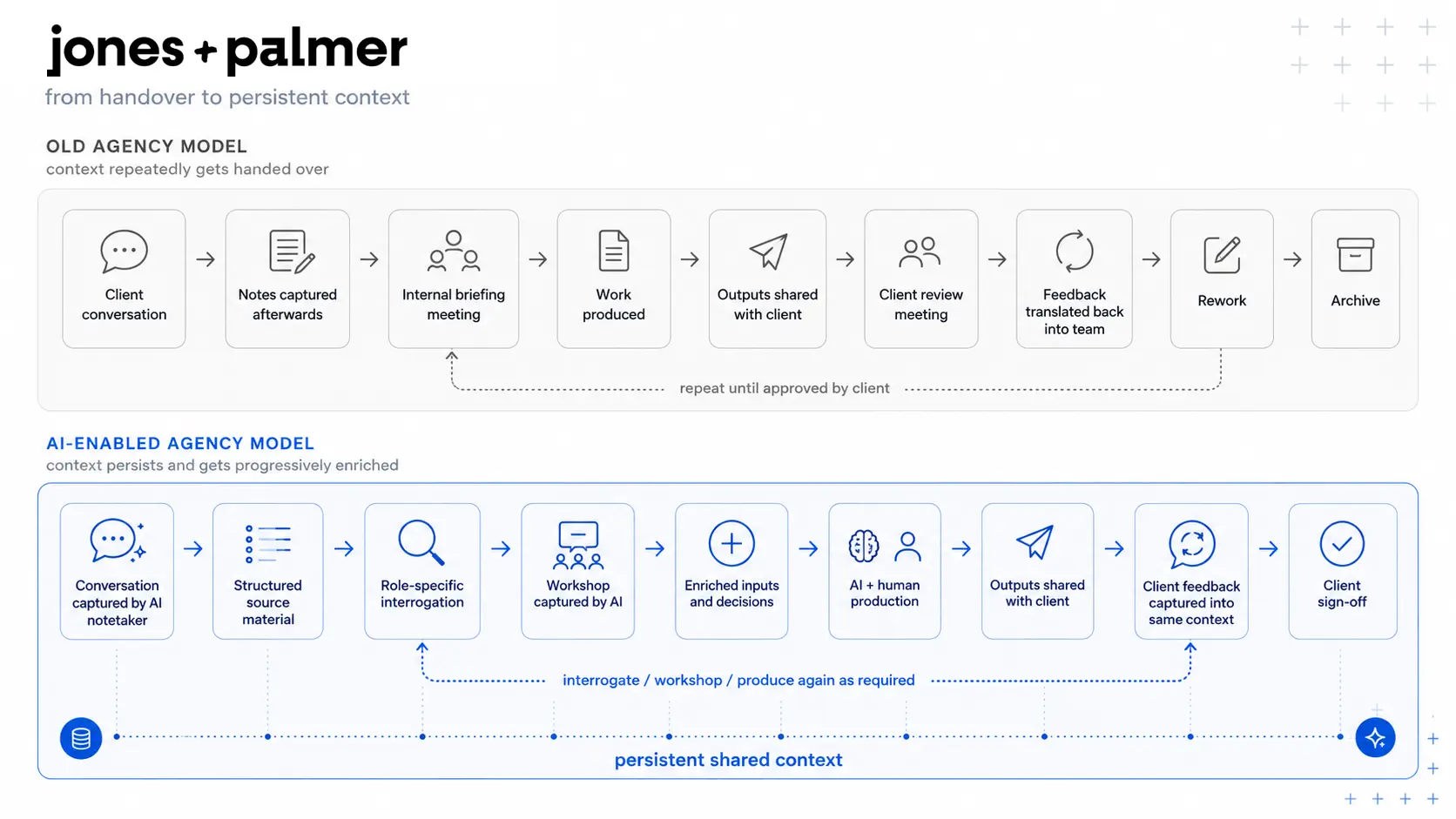
In practice, the shift is less about adding AI to the old agency process, and more about changing how context moves through the work.
The transcript is an input, not a record
This is the golden thread, and I believe it’s the bit worth taking away.
If we’ve recorded a conversation with a client or a prospect, we have the brief. We can share the transcript and video with the team. You don’t need a meeting for that. The handover has already happened, and you have a pure account of it. A consultant can interrogate the transcript with specific questions. Creatives will have different needs. Instead of everyone receiving the same handover, each person can explore the source material through the lens of their role.
So, when we get into a room – physically or virtually – everyone is already briefed. What remains is what nobody could do alone: shape the thinking, challenge it and build the solution. The notetaker comes with us. Photos of the whiteboards go in. Doodles, notes, everything goes into the melting pot. And, critically, it goes in as raw material for what we build next, not as minutes filed somewhere.
“The AI transcript creates personalised context for any role.”
That also removes something that often undermines workshops: the administrative task sitting inside the creative one. You used to spend the last stretch of a workshop capturing it, and what you captured was the notes and the walls. It was easy to lose the most valuable part of the conversation. In my experience, the gem is usually in the conversation itself. AI can help people notice patterns, omissions and inconsistencies across that conversation.
We use this process internally and with clients to work through complex, interconnected challenges.
The recording question
People are naturally wary, and they should be. We always ask permission and we always flag that the notetaker is there, along with why: it improves the quality of what everyone walks away with. Most of our clients use notetakers themselves and understand how useful the resulting record can be.
The counterintuitive part is what it did to us. We record our video calls and use them to appraise our own performance. What did we think? Did the prospect or client find that useful? What would we change? What about my delivery? That has made critique safer rather than riskier, which is the opposite of what most people assume recording does to a team.
Two things make it work, and neither of them is the technology.
The first is symmetry. Everybody puts their own material in and asks for feedback on it. You’re critiquing someone this week knowing they’ll be critiquing you next week. That’s what makes it safe. If we only reviewed the less experienced team members’ calls, we’d have built exactly the surveillance culture everyone fears.
"AI didn’t create psychological safety. The rules around its use did."
The second is that the feedback points forward. Nobody says, “my observation was that you were defensive”. They say, “next time you get asked that, I’d look to solve it like this”. Even where the first version would be accurate, the convention is to aim at the next conversation rather than pass a verdict on the last one. The recording lets you be specific. The convention stops specifics turning into a list of judgements. The takeaway here is that AI didn’t create psychological safety. The rules around its use did.
Like any technology, recordings can be misused. This isn’t about broadcasting transcripts. Recording leaves a record, so the same discipline applies as with anything published or stored online: act as though what you say could travel. In a professional environment, be mindful of which room you’re in. People will still make mistakes and, in a creative internal workshop, you have to let the work of the room happen anyway or you get nothing worth having.
Who found it hard
I still stand by the book Crossing the Chasm by Geoffrey Moore. Any significant change tends to follow that adoption curve, and AI has been no different.
What surprises you every time is who sits where. It isn’t a type of person. You cannot predict from someone’s role, age or temperament whether they’ll leap at it or hold back. The people who were wary raised predictable questions: is this surveillance, will it be used against me and what happens if I say the wrong thing and there’s a record of it? Those are reasonable questions and they deserve a straight answer rather than an enthusiasm campaign.
What changed their minds wasn’t an argument. It was seeing a transcript they were part of turn into a solution, and realising the technology hadn’t come for their craft. It had come for the gap between what they could imagine and what they could afford to build.
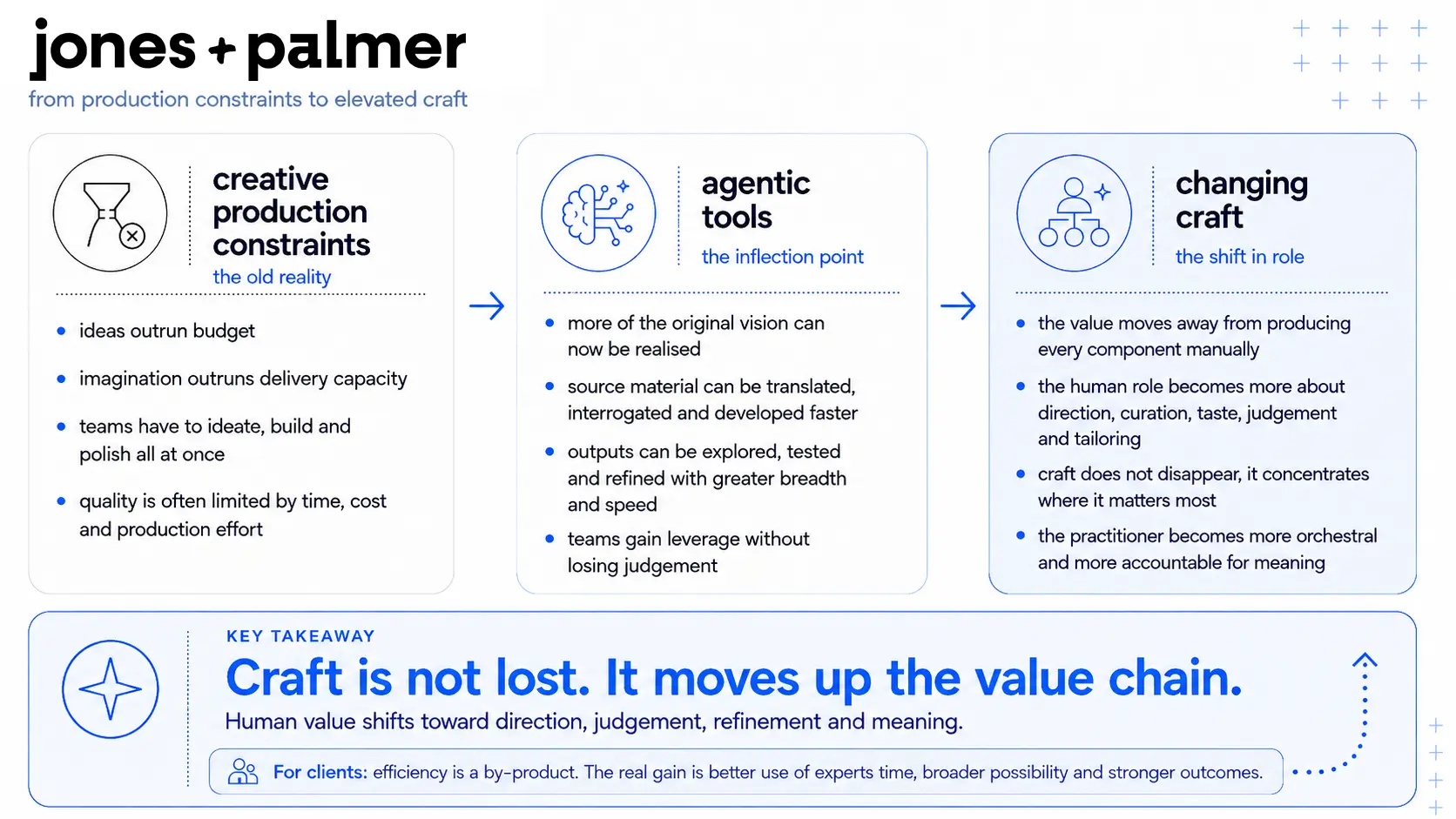
Every good team knows that gap. Your vision was worthy of a Hollywood blockbuster level of production. The reality was that budget and time might only get you and your collaborators ten per cent of the way there. What you shipped was commercially viable and met the brief, but the idea was so much better than the execution that you filed it under “if only, one day”. That gap existed because people were expected to ideate, build and polish everything themselves, until time, budget or capacity ran out.
What changes next isn’t just the workflow. It’s the relationship between ambition, execution and the role of the practitioner.
But with agentic tools, you can close a lot of those gaps now. Once someone has experienced that on a piece of work they care about, much of the wariness disappears. Their role shifts towards directing the outcome rather than producing every part themselves, while still judging and refining what comes back. The craft doesn’t disappear. It becomes concentrated where human judgement matters most: tailoring the work and aligning it with the original vision and the client’s challenge.
Part of what makes adoption so demanding is that this isn’t a single change. It’s a network of interconnected changes, because AI increasingly sits across the tools, workflows and systems people already use. Organisations aren’t simply adding another technology. They’re unpicking established ways of working and rebuilding them. You can’t just plug AI into an existing production workflow, optimise what already exists and expect that to keep you relevant.
What still has to be human?
The machine can analyse the material and play it back extraordinarily well. But deciding what matters, what it means and what we should do about it remains our responsibility. Our people appraise what comes back, apply judgement and decide which insights are useful and what deserves further exploration.
“Contributing to the input is what gives you ownership of the output.”
That’s also the condition for adoption, and it’s why the workshop matters rather than being a nicer word for a meeting. People adopt these tools more readily when they retain ownership and can still exercise judgement. Once someone understands that the room is an integral input to the process, not a discussion held alongside it, they embrace it. Contributing to the input is what gives you ownership of the output. Sit in a briefing and the solution arrives as someone else’s. Sit in a workshop and it comes back partly yours, which is the difference between appraising something and being handed it.
“AI makes participation more important, not less.”
And a workshop isn’t self-organising. It needs a facilitator who keeps the room focused on its purpose and a defined outcome from the start. That was true of good meetings and it’s just as true now. A workshop without a purpose is only a longer meeting. From my experience working with clients, AI makes participation more important, not less.
The takeaway
If your business is exploring or adopting AI, ask what people can create, challenge or decide together that they couldn’t do alone. Assume the information transfer has already happened, or can happen. Then, ask what the room is actually for.
We’re still learning and embedding this into how we work. Once AI lets us go wider, deeper and faster, the question isn’t how to have fewer meetings. It’s why we would gather a group of minds capable of solving a problem and spend their time transferring information instead.

